
EHR Integration Services
Connect systems, streamline data exchange, and support clinical workflows.
Healthcare teams need data to move between systems without delays. Our EHR Integration Services connect clinical and operational tools so workflows stay aligned, records stay consistent, and reporting stays reliable across your environment.
Overview
The EHR Integration Services connect your EHR with the systems you rely on every day. That includes interoperability for scheduling, labs, imaging, billing, patient portals, and analytics. The goal is simple: reduce manual work, improve data accuracy, and keep workflows moving. This work often includes EHR data integration so key records stay consistent across connected platforms.
Why EHR Integrations Matter in Healthcare
When systems don’t talk, staff do extra work. Data gets re-entered. Errors happen. Reports take longer. Strong EHR integrations help avoid those issues by making data exchange structured and reliable.
Benefits you’ll notice
- Less manual data entry across departments
- Cleaner, more consistent clinical and operational data
- Faster workflows across scheduling, labs, imaging, and billing
- Fewer delays caused by disconnected systems

EHR Integration Capabilities You Can Explore
Each service below is part of our EHR Integration Services. These are written as standalone sections so you can link each one to its own page naturally.
Cerner environments often connect with many systems across the organization. Cerner EHR Integration helps align data exchange, reduce interface friction, and keep connected workflows stable as systems evolve.
Healthcare data exchange needs structure and standards. Custom HL7 / FHIR Interfaces Development supports secure, accurate communication between systems and helps build interoperability based on real workflow needs.
Systems We Commonly Integrate
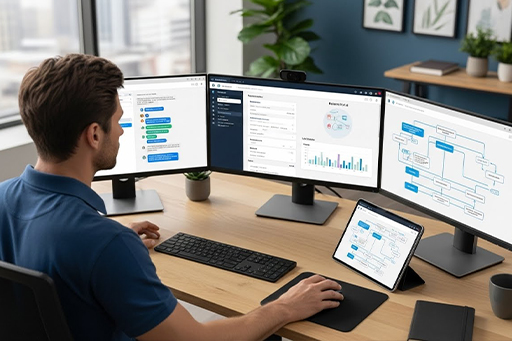
Healthcare environments run on multiple systems. Our EHR software integration services commonly connect EHR workflows with the platforms that support clinical, operational, and administrative functions.
- Lab and diagnostic systems
- Imaging and radiology systems
- Billing and revenue cycle systems
- Scheduling and registration workflows
- Patient portals and communication tools
- Document management and clinical forms
- Reporting and analytics platforms
- Identity and access management tools
Common Integration Challenges We Help Fix
Disconnected systems create friction across clinical and operational workflows. We identify and resolve integration issues that slow teams down, compromise data accuracy, or interrupt patient care.
Challenges we routinely address
- Duplicate data entry caused by disconnected systems
- Interface errors that break message flow
- Inconsistent patient records across platforms
- Delays in lab, imaging, or billing data exchange
- Mapping and transformation issues between systems
- Reporting gaps due to missing or mismatched data
- Workflow slowdowns during system updates or migrations

How Our EHR System Integration Process Works
We keep implementation structured so integration work stays predictable and aligned with daily operations.
Discover
Identify systems, workflows, and data exchange requirements.
Design
Define mapping, routing, and validation rules for data movement.
Build
Implement interfaces and connection logic with structured testing.
Validate
Confirm data accuracy, stability, and workflow continuity before go-live.
This approach supports reliable electronic health record integration without adding chaos to daily operations.
Why Choose MediSure
Choosing from EHR integration companies is about stability, accuracy, and workflow fit. We focus on building integrations that support real operations, not just technical connectivity.

What you get with MediSure
- Structured implementation and validation approach
- Workflow-focused EHR integration in healthcare environments
- Interface development aligned with standards and data accuracy needs
- Clear documentation and predictable handoff
Who We Support
MediSure Solution offers specialized healthcare IT services and support for a variety of industries, ensuring each sector’s unique needs are met with secure, efficient, and compliant technology. Here’s how we help:

Hospitals
Secure IT systems ensuring uptime, data safety, and smooth healthcare operations.

Medical Centers
Modernizing IT systems for flexibility and reliability in patient care.

Medical Laboratories
Faster, more reliable results with IT systems ensuring accuracy and compliance.

Pharmaceutical and Biotech Companies
Intelligent IT systems for secure data, compliance, and global collaboration.

Healthcare Product Companies
Enhancing security, improving workflows, and ensuring smooth operations.

Healthcare Startups
Empowering startups with secure, efficient IT infrastructure.

Pharmacy Chains & Specialty Pharmacies
Managing and securing critical IT systems for enhanced performance.

Orthopedic Centers
Optimizing IT systems to improve patient care and reliability.

Digital Health & Wearable-Tech Startups
Providing secure IT systems that drive innovation and support scalable growth.
Frequently Asked
Questions
Get answers to common questions about our 24/7 healthcare IT support services, staffing, processes, and service capabilities.
Our EHR Integration Services include planning, interface development, data mapping, testing, validation, and go-live support to connect systems and enable reliable data exchange across healthcare environments.
EHR data integration focuses on how data is mapped, transformed, and validated between systems. EHR system integration includes the broader connectivity between platforms and the clinical and operational workflows that depend on that data.
Yes. We work within the integration approaches used in your environment, including structured interface workflows and validation practices designed specifically for healthcare systems.
Yes. MediSure supports EHR software integration for environments where workflows require custom data routing, mapping, and validation to support real operational needs.
We reduce integration errors through structured testing, clearly defined validation rules, and thorough documentation to prevent mapping issues and message flow failures.
Yes. Cerner EHR Integration is a dedicated service area. We support integration planning, interface workflows, testing, and validation for Cerner-connected systems.
Ready to Get Started?
If you need 24x7 managed IT services that support healthcare operations without disruption, our team is ready to help.
Call us now: +1 (951) 622-8126