
Healthcare organizations rely on technology every hour of the day. Hospitals, clinics, urgent care centers, diagnostic labs, specialty practices, telehealth providers, and multi-location healthcare networks all depend on digital systems to keep patient care moving. Electronic Health Records, Electronic Medical Records, patient portals, telemedicine platforms, billing systems, scheduling tools, PACS, clinical applications, workstations, tablets, mobile devices, and medical devices all need reliable support.
Because healthcare operations do not stop after normal business hours, many organizations need 24×7 IT help desk support. But before choosing a provider, one of the most important questions is cost.
A 24×7 IT help desk quote for healthcare is a detailed pricing estimate or service proposal for round-the-clock technical support. It explains what services are included, how support is delivered, how issues are escalated, what response times are promised, and how the final price is calculated.
For healthcare organizations, this quote should not be a generic IT support estimate. It should be based on clinical workflows, compliance needs, EHR/EMR systems, staff count, device count, ticket volume, network complexity, cybersecurity requirements, and the level of support required.
This guide explains how 24×7 healthcare IT help desk pricing works, what a quote usually includes, which pricing models are common, what cost drivers affect the estimate, and what information you should prepare before submitting a proposal request.
What Is a 24×7 IT Help Desk Quote for Healthcare?
A 24×7 IT help desk quote for healthcare is a customized cost estimate for continuous technical support designed for medical organizations. It usually covers support for clinical staff, administrative staff, remote teams, patient-facing systems, and healthcare technology infrastructure.
The quote may include support for:
- EHR and EMR systems
- PACS and imaging platforms
- Telehealth platforms
- Patient portals
- Practice management systems
- Billing and claims systems
- Workstations and laptops
- Tablets and mobile devices
- Network connectivity
- Printers and scanners
- Cloud applications
- Cybersecurity alerts
- User access and password resets
- Medical device integration support
The goal of the quote is to help your organization understand the monthly or annual cost of reliable 24×7 support. A good quote should also explain service levels, support scope, compliance responsibilities, reporting, escalation paths, and any extra charges.
Why Pricing Matters in Healthcare IT Support
Healthcare downtime can be extremely expensive. In many cases, downtime may cost healthcare organizations thousands of dollars per minute when it affects patient care, EHR access, billing, scheduling, or clinical operations.
A system outage can create several problems at once. Doctors may not be able to access patient records. Nurses may not be able to update documentation. Front-desk staff may not be able to verify insurance. Billing teams may face claim delays. Telehealth visits may be interrupted. Patients may experience longer wait times.
This is why healthcare IT support pricing should be viewed as both a cost and a risk-management decision. The cheapest option may not provide enough coverage, while an overbuilt plan may cost more than necessary.
The right quote should balance cost, coverage, response time, compliance, and support quality.
Typical 24×7 IT Help Desk Pricing for Healthcare
24×7 IT help desk pricing for healthcare organizations can vary based on size, systems, support level, and service model. However, common pricing ranges include:
- Per-user pricing: typically $125 to $250 per user, per month
- Per-ticket or per-incident pricing: often $10 to $40 per ticket, with some resolved ticket pricing around $15 to $40
- Dedicated agent or FTE model: around $2,500 to $4,500 per agent, per month
- Dedicated healthcare support teams: often $3,000 to $8,000+ per month, depending on the number of agents and technical tiers required
- Per-device pricing: often $30 to $80 per device, per month for basic monitoring and support
These numbers are not fixed for every organization. Your final IT support estimate depends on your total staff, device count, ticket volume, network complexity, required compliance standards, software stack, and whether you need general Tier 1 support or specialized L1-L3 clinical application support.
Adding 24×7 coverage to a standard 8-to-5 IT support plan may also increase the monthly base cost by around 20% to 30%, depending on the provider and scope.
Key Pricing Models for 24×7 Healthcare IT Help Desk Support
Most healthcare organizations are quoted under one of several pricing models. Understanding these models helps you compare providers more accurately.
1. Per-User Pricing
Per-user pricing is one of the most common models for healthcare IT help desk support. In this structure, your organization pays a monthly fee for each employee or user who needs support.
Typical pricing may range from $125 to $250 per employee per month for 24×7 healthcare IT help desk support.
This model usually covers all devices used by that employee, such as desktops, laptops, tablets, and mobile devices. For example, if a nurse uses a workstation, tablet, and mobile access, all support may be included under that user.
Per-user pricing is useful because it is predictable. Healthcare leaders can estimate cost based on staff count and scale the plan as the organization grows.
This model works well for:
- Clinics
- Specialty practices
- Urgent care centers
- Multi-location medical groups
- Healthcare organizations with stable staff counts
- Teams that want predictable monthly billing
The main advantage is simplicity. The main limitation is that the cost can increase quickly if your organization has many users, even if not all users submit frequent tickets.
2. Per-Ticket or Per-Incident Pricing
Per-ticket pricing means your organization pays based on the number of support requests resolved. This model may range from $10 to $40 per ticket, depending on issue severity, support level, and ticket volume. Some resolved ticket models may range from $15 to $40 per resolved ticket.
This structure can work well if your after-hours support volume is low. For example, if your organization only receives occasional weekend or overnight tickets, per-ticket pricing may be more cost-effective than a full per-user model.
However, many providers include a monthly minimum commitment. This means you may still pay a base amount even if ticket volume is low.
Per-ticket pricing can work for:
- Small practices
- Low-volume after-hours support
- Organizations testing outsourced help desk services
- Clinics with limited ticket history
- Healthcare teams that only need backup support
The advantage is flexibility. The risk is unpredictability. If ticket volume increases suddenly, monthly costs may rise quickly.
3. Per-Device Pricing
Per-device pricing is based on the number of endpoints or devices that require support. This may include workstations, laptops, tablets, mobile devices, servers, printers, scanners, and some medical devices.
Basic monitoring and support may cost around $30 to $80 per device, per month, depending on the device type and service scope.
This model is useful when your organization has many shared devices. For example, clinics often have front-desk computers, exam room workstations, nursing stations, scanning devices, and shared tablets.
Per-device pricing works well for:
- Clinics with shared workstations
- Labs with multiple connected devices
- Multi-location practices
- Organizations with a large endpoint inventory
- Teams that need monitoring for specific devices
The quote should clearly define which devices are included and whether servers, medical devices, printers, and network equipment are priced differently.
4. Dedicated Agent or FTE Pricing
Dedicated agent pricing gives your healthcare organization access to one or more dedicated support agents. These agents may be assigned specifically to your organization and trained on your workflows, systems, users, and processes.
Dedicated agent pricing may range from $2,500 to $4,500 per agent, per month. Larger dedicated healthcare support teams may range from $3,000 to $8,000+ per month, depending on agent count, technical skill level, coverage hours, and whether agents are US-based.
This model is often best for:
- Large hospital networks
- Health systems
- High-volume healthcare groups
- Organizations with complex workflows
- Teams requiring specialized EHR or clinical application support
- Providers needing dedicated US-based healthcare agents
The biggest advantage is specialization. Dedicated agents learn your systems and workflows deeply. The main limitation is cost, especially if multiple agents are needed for true 24×7 coverage.
Healthcare-Specific Cost Drivers
Healthcare IT support is often more complex than standard business IT support. Several healthcare-specific factors can increase the cost of your quote.
1. EHR and EMR Support
EHR and EMR systems are central to healthcare operations. If staff cannot access patient records, update clinical notes, view lab results, or process documentation, patient care can be delayed.
Providing 24×7 support for systems such as Epic, Cerner, Meditech, eClinicalWorks, Athenahealth, or other EHR/EMR platforms often requires more specialized technicians.
Basic Tier 1 support may handle password resets, login troubleshooting, and simple access issues. More advanced Tier 2 and Tier 3 support may be needed for application errors, workflow issues, integration problems, performance concerns, and vendor coordination.
Because EHR/EMR support requires healthcare knowledge, it can increase the base cost of the help desk quote.
2. Clinical Application Support
Healthcare organizations may also need support for PACS, radiology systems, lab systems, telehealth platforms, patient portals, billing systems, claims platforms, scheduling software, and practice management systems.
A general IT help desk may not be able to support these systems properly. Clinical application support often requires technicians who understand medical workflows, patient-facing systems, and healthcare software dependencies.
Your quote may cost more if you need L1-L3 clinical application support instead of general Tier 1 technical assistance.
3. HIPAA, HITECH, and Compliance Requirements
Healthcare IT support must be handled with strong security and privacy controls. If a provider may access systems containing protected health information, compliance responsibilities become extremely important.
Healthcare help desk pricing may be higher when the provider must support:
- HIPAA-aligned processes
- HITECH considerations
- Business Associate Agreement requirements
- Secure agent workstations
- Encrypted communication
- Audit trails
- Secure access controls
- Role-based permissions
- Continuous security training
- Incident documentation
- User identity verification
A provider that understands healthcare compliance may cost more than a general help desk vendor, but it also reduces risk.
4. Network Complexity
The more complex your IT environment, the more support effort is required. A single-location clinic with basic cloud tools will usually cost less than a multi-location healthcare group with servers, VPNs, firewalls, EHR integrations, medical devices, telehealth platforms, and remote staff.
Network complexity may include:
- Number of locations
- Number of servers
- Cloud infrastructure
- VPN access
- Firewall management
- Internet redundancy
- Medical device connectivity
- Remote access needs
- Backup and disaster recovery setup
- Wireless network requirements
A provider may perform a service assessment before giving a final quote to understand these technical details.
5. Ticket Volume
Ticket volume has a direct impact on pricing. If your organization generates a high number of support tickets, the provider needs more staffing, tools, and escalation capacity.
Before requesting a quote, review your current internal ticketing data. Look at:
- Average monthly tickets
- After-hours ticket volume
- Weekend ticket volume
- EHR-related tickets
- Password reset volume
- Recurring issues
- Critical incidents
- Average resolution time
If you do not have ticketing data, the provider may estimate volume based on staff count, device count, and organization type.
6. SLA Response Time Needs
SLA response time defines how quickly the support provider must respond to different types of issues. Faster SLA commitments usually increase cost because the provider needs enough staff available at all times.
For example, a critical EHR outage affecting multiple departments requires a much faster response than a single user’s non-urgent software question.
Your quote should define response times for:
- Critical issues
- High-priority issues
- Medium-priority issues
- Low-priority issues
The stricter the SLA, the higher the support cost may be.
7. 24×7 Coverage Requirements
Adding 24×7 support to a standard 8-to-5 IT plan can increase the monthly base cost by 20% to 30%. This is because the provider must staff support teams overnight, on weekends, and during holidays.
Healthcare organizations should confirm whether they need:
- True 24x7x365 live support
- After-hours emergency-only support
- Weekend support
- Holiday support
- Dedicated overnight agents
- US-based support
- Global support coverage
- Patient-facing support
The more complete the coverage, the higher the quote may be.
What a 24×7 Healthcare IT Help Desk Quote Should Include
A strong quote should give more than a monthly price. It should clearly explain what your organization receives.
Your quote should include:
- Monthly or annual cost
- Pricing model
- Number of supported users
- Number of supported devices
- Included support channels
- Support hours
- SLA response time commitments
- Ticket escalation process
- EHR/EMR support scope
- Clinical application support scope
- Cybersecurity support
- HIPAA-aligned processes
- BAA requirements
- Reporting and analytics
- Onboarding process
- Exclusions
- Extra charges
- Contract terms
- Cancellation terms
If any of these items are missing, ask the provider for clarification before approving the proposal.
Getting an Accurate Quote
To receive an accurate and tailored quote, prepare the right information before contacting Managed IT Service Providers or healthcare IT vendors.
1. Total User Count
Know how many clinical and administrative users need support. This includes doctors, nurses, front-desk staff, billing teams, administrators, remote workers, and leadership.
User count is especially important for per-user pricing.
2. Device Breakdown
Prepare a list of devices that require support, including:
- Workstations
- Laptops
- Tablets
- Mobile devices
- Printers
- Scanners
- Servers
- Network devices
- Medical devices
Device count is important for per-device pricing and monitoring estimates.
3. Primary EHR/EMR Platform
Vendors usually need to know which EHR or EMR platform they will support. This may include Epic, Cerner, Meditech, eClinicalWorks, Athenahealth, or other systems.
The platform matters because some systems require specialized knowledge and vendor coordination.
4. Primary Technology Stack
Make a list of your core technology platforms, including:
- Telemedicine platforms
- Clinical applications
- PACS
- Billing systems
- Scheduling tools
- Patient portals
- Cloud applications
- Security tools
- Medical devices
- Communication systems
This helps the provider understand the support scope.
5. Ticket Volume
Provide current internal ticketing data if available. Providers use this to estimate after-hours support demand, weekend usage, staffing needs, and pricing.
If you do not have formal ticket data, estimate common issues and monthly support requests.
6. SLA Needs
Clearly define your required maximum response times for critical and non-critical issues.
For example:
- EHR outage affecting multiple users
- Network outage at one location
- Telehealth issue during a patient visit
- Password reset for one user
- Printer issue in one department
- Security alert
This helps the provider design the right support plan.
7. Scope of Support
Define whether you need general Tier 1 support or specialized L1-L3 clinical application support.
General Tier 1 support may be enough for basic troubleshooting. However, healthcare organizations with complex EHR/EMR systems, PACS, telehealth, or multi-location operations may need advanced support tiers.
Service Assessment Before Pricing
A service assessment is often the best first step before receiving a final quote. During the assessment, the provider reviews your current systems, risks, support needs, and operational requirements.
A service assessment may include:
- Staff review
- Device inventory
- Network review
- EHR/EMR review
- Ticket history review
- Security process review
- Compliance review
- Vendor review
- SLA discussion
- Support gap analysis
This helps the provider create a more accurate IT support estimate instead of giving a generic price.
Using a Pricing Calculator
Some providers may offer a pricing calculator to estimate 24×7 IT help desk costs. A pricing calculator may ask for:
- Number of users
- Number of devices
- Support hours
- Ticket volume
- Number of locations
- EHR/EMR support needs
- Security requirements
- SLA level
A pricing calculator can provide a helpful starting point, but healthcare organizations should still request a detailed proposal. Healthcare IT support is complex, and the final quote should reflect your real systems and workflows.
How to Compare Multiple Quotes
When comparing quotes, do not choose only by price. A cheaper quote may exclude important services such as EHR support, HIPAA-aligned processes, after-hours coverage, reporting, or escalation.
Compare each quote based on:
- Support availability
- Pricing model
- SLA response times
- Support channels
- EHR/EMR support
- Clinical application support
- Security processes
- BAA readiness
- Ticket escalation
- Reporting
- Provider healthcare experience
- Contract flexibility
- Extra charges
Make sure every provider is quoting the same scope. A quote for emergency-only after-hours support is not the same as true 24x7x365 live support.
Questions to Ask Before Accepting a Proposal
Before approving a proposal request, ask these questions:
- Is support truly available 24x7x365?
- What pricing model are you using?
- What is included in the monthly fee?
- What costs extra?
- Do you support EHR and EMR systems?
- Do you support PACS and telehealth platforms?
- Do you provide Tier 1, Tier 2, and Tier 3 support?
- What are your SLA response times?
- How do you handle critical incidents?
- Do you provide HIPAA-aligned support?
- Will a Business Associate Agreement be required?
- Do you use secure agent workstations?
- Do you provide audit trails and access controls?
- What reports will we receive?
- How long does onboarding take?
- Do you support patient-facing help desk needs?
- Do you offer dedicated agents or shared support?
Clear answers will help your organization avoid hidden costs and support gaps.
When Dedicated Agents Make Sense
Dedicated agents are usually best for larger healthcare organizations with high ticket volume or specialized workflows.
This model may make sense if:
- Your organization has multiple locations
- Ticket volume is high
- EHR/EMR support is complex
- Clinical workflows require specialized training
- You need US-based agents
- You want consistent support staff
- You need patient-facing help desk support
- You operate a large hospital network or health system
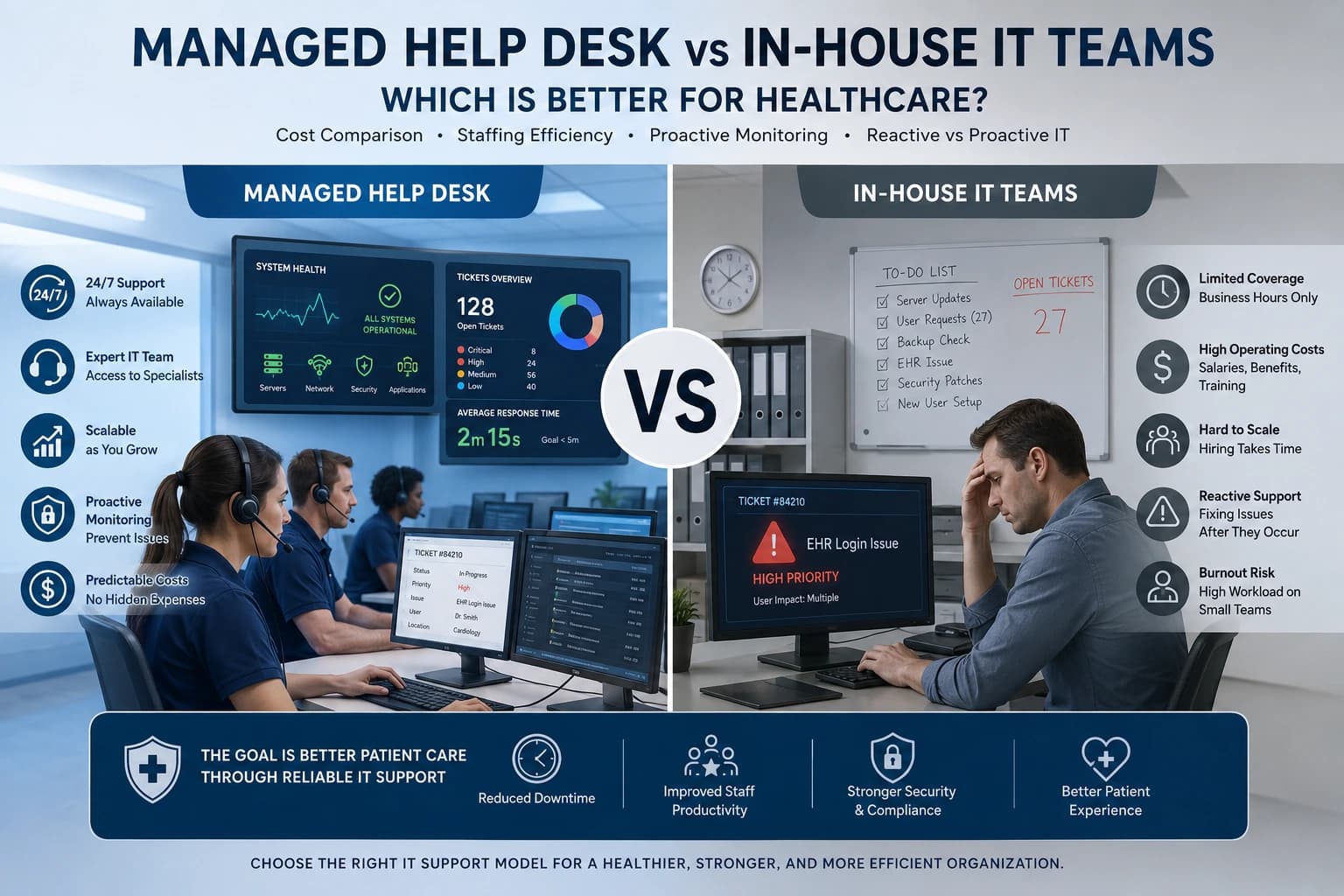
For smaller clinics, shared help desk support may be more cost-effective.
Patient Help Desk as an Optional Add-On
Some healthcare organizations also need patient-facing support. This may include help with appointment scheduling, patient portal navigation, telehealth access, password resets, and basic digital support.
Patient help desk services may be quoted separately because they require different workflows, communication standards, and sometimes higher call volume.
If your organization needs patient support, include it in your proposal request from the start.
Final Thoughts
Getting a 24×7 IT help desk quote for your healthcare organization is not just about finding the lowest monthly price. It is about understanding the support model, service scope, compliance responsibilities, response times, escalation process, and long-term value.
Healthcare organizations should expect pricing to vary based on users, devices, ticket volume, EHR/EMR support, clinical application complexity, HIPAA requirements, SLA needs, and whether support is shared or dedicated.
Common pricing models include per-user pricing, per-ticket pricing, per-device pricing, and dedicated agent pricing. Per-user pricing may range from $125 to $250 per user per month. Per-ticket pricing may range from $10 to $40 per ticket, with some resolved ticket models around $15 to $40. Dedicated agents may range from $2,500 to $4,500 per agent per month, while larger dedicated teams may range from $3,000 to $8,000+ per month.
Before requesting a quote, prepare your headcount, device count, ticket volume, primary EHR/EMR platform, technology stack, SLA needs, and support scope. A service assessment or pricing calculator can help create a starting estimate, but a detailed proposal request is the best way to get accurate pricing.
The right healthcare IT help desk provider should support your staff, protect patient data, reduce downtime, improve EHR continuity, and help your organization deliver uninterrupted patient care.
FAQs
1. What is a 24×7 IT help desk quote for healthcare?
A 24×7 IT help desk quote for healthcare is a customized pricing estimate for round-the-clock IT support. It usually includes support scope, pricing model, SLA response times, user count, device count, EHR/EMR support, compliance responsibilities, and reporting.
2. How much does 24×7 IT help desk support cost for healthcare?
Pricing may range from $125 to $250 per user per month, $10 to $40 per ticket, $30 to $80 per device per month, or $2,500 to $4,500 per dedicated agent per month. Final pricing depends on your organization’s needs.
3. What affects the cost of healthcare IT help desk support?
The main cost drivers include staff count, device count, ticket volume, EHR/EMR complexity, HIPAA requirements, network complexity, SLA response time needs, support hours, and whether dedicated agents are required.
4. Is per-user pricing better than per-ticket pricing?
Per-user pricing is better for predictable monthly support and higher ticket volume. Per-ticket pricing may work better when after-hours support volume is low, but costs can rise if ticket volume increases.
5. Why does EHR/EMR support increase pricing?
EHR/EMR support often requires specialized healthcare IT knowledge and Tier 2 or Tier 3 support. Systems like Epic, Cerner, Meditech, or eClinicalWorks may require advanced troubleshooting and vendor coordination.
6. Does 24×7 healthcare IT support include HIPAA compliance?
A healthcare-focused provider should follow HIPAA-aligned processes such as secure access, audit trails, encrypted communication, user verification, and proper documentation. If protected health information may be accessed, a Business Associate Agreement may be needed.
7. What should I prepare before requesting a quote?
Prepare your total user count, device breakdown, ticket volume, EHR/EMR platform, technology stack, support hours, SLA needs, compliance requirements, and whether you need general Tier 1 support or specialized L1-L3 clinical application support.